
December – An astonishing year in review
2025’s January effect was strong on the back of lowering inflation and strong Q4 2024 corporate results. But the first quarter of the year quickly turned nightmarish in the wake of a first wave of tariffs being implemented. US indices were hurting the most on fear that the tariffs would mean the return of an inflation that took so long to tame post Covid. The Nasdaq, for example, was down more than -10%. Investors had every right to panic at this point, but all of our partners remained headstrong and committed and did not regret it, with hindsight.
Then came “Liberation Day”, marked by anxiety and sleep deprivation as most global markets took a -15% hit over a 3-day period. At this point, it became clear that we were no longer in a financial world ruled by core economic fundamentals, but rather one that moves at the whims of just one person. The rest of the quarter completely erased the losses and more. This was attributable to the pause in tariffs given to countries to come back with a business offer to make up for the perceived imbalance. But given the geopolitical context (Ukraine-Russia peace talk collapse, Iran-Israel-US short war) we should consider ourselves rather lucky.
In Q3, tariffs finally started to come into effect and brought their lot of uncertainties, in particular with the impact they would have on inflation, profitability and, in turn, interest rates. Despite the uncertainty, there was no stopping the stock markets from breaking one record high after another. The Fed resuming to cut rates at the end of the quarter further fueled enthusiasm.
Q4 started off on day 1 with a US government shutdown, followed by a little scare over AI stocks. But all that didn’t stop the financial markets in their ascent. Finally, as the year drew to a close, the pessimistic data were just enough to slow down the momentum, but not enough to turn the trend around, with the Fed helping out a little by cutting rates for the 3rd time in as many meetings following an encouraging inflation figure. The negative data are rising unemployment, continuing contraction in manufacturing PMIs, poor consumer confidence.
Data source : Bloomberg
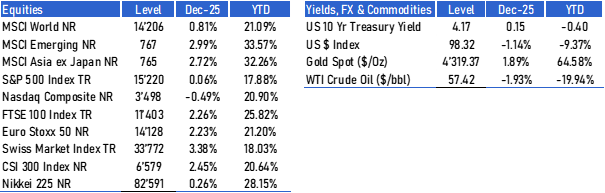
Looking back at the 2025 vintage, it turned out to be a year of everything rally, something unseen since the Covid pandemic. All major asset classes delivered positive performance, with precious metals leading the pack with gold up over 60% and silver over 140%, though the other commodities can’t compare. Then came emerging market equities, ending the year at +34% and developing markets behind at +21%. On the fixed income side, emerging market debt was also the big winner at +13%. With hindsight, our avoidance of emerging markets and non-US developed markets, which we perceived as having the highest to lose in the trade war and with a President that is all about America first, was our weakest bet. Some indices such as the MSCI Spain and MSCI Austria surged seemingly out of nowhere, performing around 60% in EUR and over 80% in USD terms.
Our summary recommendations
One of our biggest worries for 2025 was geopolitical risk, and with what happened In Venezuela at the time of writing and the dangerous rhetoric coming out of the US, we sadly believe that it will remain center stage in 2026.
Another one of our worries was the trade war, but in the end, tariffs were not as big a deal as we and most economists had anticipated.
2026 will have 2 significant events as far as investments are concerned. In May, current Fed chair Powell’s mandate will expire and the new chair, appointed by President Trump, is likely to be acting as a puppet, likely to result in interest rates going down significantly. The other significant event is the US midterm election, which will either consolidate Trump’s power or rein him in and perhaps even result in his impeachment.
We should also watch out for tech companies. We would like to see them start to show some sort of incremental profitability from all the AI investments, or debt and equity holders will begin to tire out.
From our side, we will remain positioned as we were at year end, meaning rather defensive in equities and significantly overweight in alternative investments and will also look at adding risk in fixed income to make up for the gradually decreasing yields.
Chart of the month
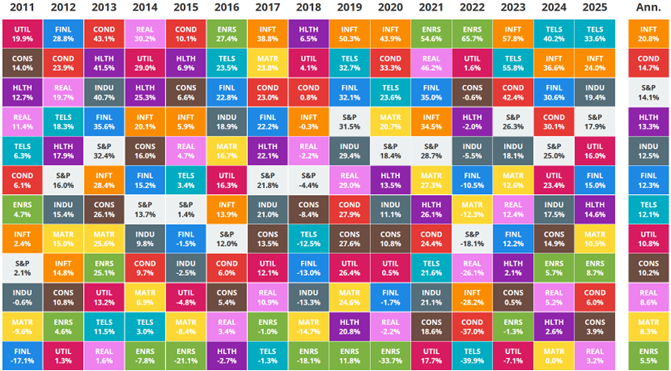
As the year comes to a close, perhaps this table makes more sense than a chart. It is a nice visual on which sectors performed best by year and on average (Communication, Information Technology, Industrials). It also shows the wide disparity between the worst and best performing sectors each year. In 2025, that range was about 30%, while some extreme years have a disparity close to 40%. This demonstrates why we are very reluctant to make sector or thematic bets in our tactical views.
Source: novelinvestor.com
Disclosures
This document has been issued by Stork Capital, registered with the Swiss Association of Asset Managers, and licensed by FINMA.
Offering Documents. This material is provided at your request for informational purposes only and is not intended as an offer, a solicitation of an offer, to buy, sell or carry out any transaction on investment instruments or other specific product, it only contains selected information with regards to Stork Capital’s services. The analysis and information contained herein do not constitute a personal recommendation or consider the particular investment objectives, investment strategies, financial situation and needs of any specific recipient. Certain services and products are subject to legal restrictions and cannot be offered worldwide on an unrestricted basis and/or may not be eligible for sale to all investors. All information and opinions expressed in this document were obtained from sources believed to be reliable and in good faith, however, Stork Capital cannot guarantee the accuracy of such content, ensure its completeness, or warrant that such information has not or will not change.
Prior to any investment, prospective investors should carefully read the latest offering documentation, including but not limited to the fund’s prospectus which contains inter alia a comprehensive disclosure of applicable risks. The relevant constitutional and offering documents are available free of charge at Stork Capital’s principal office.
Risk Information and Potential Loss. Financial advisers generally suggest a diversified portfolio of investments. The funds described herein do not represent a diversified investment by themselves. This material does not constitute investment advice and should not be used as the basis for any investment decision. This material does not purport to provide any legal, tax or accounting advice. Prospective investors should consult their financial and tax adviser before investing in order to determine whether an investment would be suitable for them.
Any investor or prospective investor should be aware of the risks inherent in trading activity, such as but not limited to currency risk, interest-rate risk, market risk, insolvency risk, and is aware that trading can be very speculative and may result in losses as well as profits. Therefore, an investor should only invest if he/she has the necessary financial resources to bear a complete loss of this investment.
Portfolio Allocations. This material contains information that pertains to past performance or is the basis for previously-made discretionary investment decisions. The value of investments may fall as well as rise and investors may not get back the amount they invested. Thus, past performance does not necessarily provide any guarantee of future results. Accordingly, this information should not be construed as a current recommendation, research or investment advice. It should not be assumed that any investment decisions shown will prove to be profitable, or that any investment decisions made in the future will be profitable or will equal the performance of investments discussed herein. Any mention of an investment decision is intended only to illustrate our investment approach and/or strategy, and is not indicative of the performance of our strategy as a whole. Any such illustration is not necessarily representative of other investment decisions.
Portfolio holdings and/or allocations shown above are as of the date indicated and may not be representative of future investments. The holdings and/or allocations shown may not represent all of the portfolio's investments. Future investments may or may not be profitable.
Intended Recipients. This material and any information contained therein shall only be for the personal use of the intended recipient and shall not be redistributed to any third party, unless Stork Capital or the source of the relevant market data gives their approval. This material is not directed to any person in any jurisdiction where (on the grounds of that person’s nationality, residence or otherwise) such documents are prohibited. In particular, neither this document nor any copy thereof may be sent, taken into or distributed in the United States or to any US person.
Disclaimer of Endorsement. References in these discussion materials to any specific manager, service provider, vendor, market, index, financial procedure, process, resources, or commercial services do not constitute nor imply its endorsement, recommendation, or favour by Stork Capital. Views and opinions expressed are for informational purposes only and do not constitute a recommendation by Stork Capital to buy, sell, or hold any security. Views and opinions are current as of the date of this presentation and may be subject to change, they should not be construed as investment advice. The website links provided are for your convenience only and are not an endorsement or recommendation by Stork Capital of any of these websites or the products or services offered. Stork Capital is not responsible for the accuracy and validity of the content of these websites.
Investment Risks. Risks vary by the type of investment. For example, investments that involve futures, equity swaps, and other derivatives, as well as non-investment grade securities, give rise to substantial risk and are not available to or suitable for all investors. We have described some of the risks associated with certain investments below and, in certain cases, earlier in this presentation. Additional information regarding risks may be available in the materials provided in connection with specific investments. You should not enter into a transaction or make an investment unless you understand the terms of the transaction or investment and the nature and extent of the associated risks. You should also be satisfied that the investment is appropriate for you in light of your circumstances and financial condition.
Alternative Investments. Private investment funds and hedge funds are subject to less regulation than other types of pooled vehicles. Alternative investments may involve a substantial degree of risk, including the risk of total loss of an investor’s capital and the use of leverage, and therefore may not be appropriate for all investors. Liquidity may be limited. Investors should review the Offering Memorandum, the Subscription Agreement and any other applicable disclosures for risks and potential conflicts of interest. Alternative Investments may be subject to less regulation than other types of pooled investment vehicles such as mutual funds. Alternative Investments may impose significant fees, including incentive fees that are based upon a percentage of the realized and unrealized gains and an individual’s net returns may differ significantly from actual returns. Such fees may offset all or a significant portion of such Alternative Investment’s trading profits. Alternative Investments may not be required to provide periodic pricing or valuation information. Investors may have limited rights with respect to their investments, including limited voting rights and participation in the management of such Alternative Investments.
Real Estate. Investments in real estate involve additional risks not typically associated with other asset classes, such as sensitivities to temporary or permanent reductions in property values for the geographic region(s) represented. Real estate investments (both through public and private markets) are also subject to changes in broader macroeconomic conditions, such as interest rates.
The sole place of jurisdiction for all disputes arising out of or in connection with this material and/or the present disclaimer and/or to the use of this material is Geneva, Switzerland, and it shall be exclusively governed by and construed in accordance with Swiss law.