March – A quarter that felt like a decade
As the first quarter of 2026 comes to a close, the human tragedy sadly goes on. Our thoughts are with our clients and friends in the Middle East that are impacted by the current events. We won’t recount this major geopolitical event, but we will address its impact on the global economy.
All indications led us to believe that we were in for another stellar vintage, until Trump pushed the button. We can’t help but have a feeling of déjà vu. If you recall last year, we were all riding a smooth wave until Trump decided to start imposing tariffs on every country, with no particular logic justifying the various levels (recently ruled out illegal by the Supreme Court), and everything collapsed.
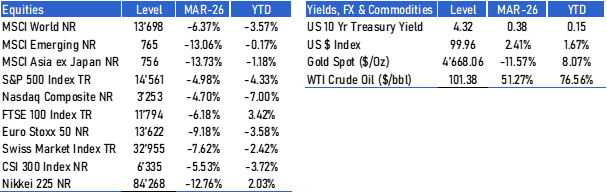
This time around, the strongest movements took place in the commodities market, both up and down (see chart of the month section). While we hope for a quick end to the hostilities, President Trump is now stuck between his inclination to avoid prolonged conflict and his will to get rid of his TACO-trade image (we discussed “Trump Always Chickens Out” in a previous insight letter). Equity markets are clearly pricing a quick end to the conflict, followed by resumption of business as usual.
Data source : Bloomberg
The final figure for the 2025 annual GDP growth just came out at a mere 2%. The US Federal Reserve is clearly also rather optimistic, predicting a similar growth rate for Q1 of this year. Given the current situation, we think there are more chances for 2026 to fare worse rather than better than the previous year. To support our thesis, we see evidence of worsening conditions in the poorer part of the population. Things like student, auto and credit card loan delinquencies are at levels not seen in decades.
So what is keeping the economy afloat, one might ask? Well, the wealth gap in the US is such that the top 20% is responsible for over 60% of the spending. The US is in what economists call a K-shaped economy, where the richest get richer at an increasingly and much faster rate than the poor. This is further exacerbated by inflation, oil and real estate prices going up. Now, if the stock market was to correct, and as a result the richest were to cut spending, both legs of the K would point downward, and this would without a doubt hurt GDP growth.
Other countries are suffering even more than the US, which is, in fact, energy self-sufficient and a net exporter. Europe for instance and some emerging economies are a lot more dependent on the Middle East for oil and gas and are having to tap into their reserves to keep up with the current needs. If the Strait of Hormuz does not reopen soon, a lot of countries will be competing for a limited resource, driving the price up and, as a result, growth down.
House View
March was a very volatile month, swinging violently to the rhythm of President Trump’s social media posts. Another reminder that it is important to stay invested throughout this sort of crisis so as not to miss the rebounds.
Clients that have followed our advice are sleeping well so far. Indeed, we have been positioned rather defensively since last year, and as a result, are barely feeling a pinch this month.
In fact, we have taken advantage of the swings in volatility numerous times this month to structure various products that strive in this sort of environment.
You may have read alarming headlines about the private credit sector in recent weeks. While it can’t be denied that the asset class is under stress at the moment, it should be specified that only a very small sub sector in private credit is taking a hit. As a consequence, some very healthy funds are being forced to gate or are on the verge of it. We like to say that a gate is there to protect investors, not to punish them. It is important to know what private credit funds are investing in and only by doing that can we be reassured that they are well positioned or even benefiting from the current stress to make cheaper acquisitions. Having spoken with all of our funds, we are very comfortable with the way they are invested.
Chart of the month
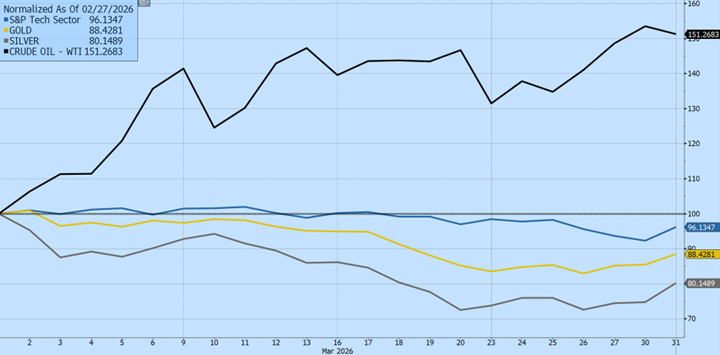
We find it appropriate to show you how some commodities have reacted compared to one of the most volatile sector of the equity market, the technology sector.
Below, the black curve is the WTI crude oil spot price, which went up over 50% in March. But that move was far from a straight line, in fact there were multiple double-digit swing in single days.
In yellow, we see the gold spot price evolution, which clearly shows that it has not played its safe haven role at all throughout the current crisis. Even worse is silver, in grey, which a lot of people got into earlier this year, down over 20%.
In comparison, the S&P500 the technology sector is reacting relatively mildly, down just under -4%.
Source: Bloomberg
Disclosures
This document has been issued by Stork Capital, registered with the Swiss Association of Asset Managers, and licensed by FINMA.
Offering Documents. This material is provided at your request for informational purposes only and is not intended as an offer, a solicitation of an offer, to buy, sell or carry out any transaction on investment instruments or other specific product, it only contains selected information with regards to Stork Capital’s services. The analysis and information contained herein do not constitute a personal recommendation or consider the particular investment objectives, investment strategies, financial situation and needs of any specific recipient. Certain services and products are subject to legal restrictions and cannot be offered worldwide on an unrestricted basis and/or may not be eligible for sale to all investors. All information and opinions expressed in this document were obtained from sources believed to be reliable and in good faith, however, Stork Capital cannot guarantee the accuracy of such content, ensure its completeness, or warrant that such information has not or will not change.
Prior to any investment, prospective investors should carefully read the latest offering documentation, including but not limited to the fund’s prospectus which contains inter alia a comprehensive disclosure of applicable risks. The relevant constitutional and offering documents are available free of charge at Stork Capital’s principal office.
Risk Information and Potential Loss. Financial advisers generally suggest a diversified portfolio of investments. The funds described herein do not represent a diversified investment by themselves. This material does not constitute investment advice and should not be used as the basis for any investment decision. This material does not purport to provide any legal, tax or accounting advice. Prospective investors should consult their financial and tax adviser before investing in order to determine whether an investment would be suitable for them.
Any investor or prospective investor should be aware of the risks inherent in trading activity, such as but not limited to currency risk, interest-rate risk, market risk, insolvency risk, and is aware that trading can be very speculative and may result in losses as well as profits. Therefore, an investor should only invest if he/she has the necessary financial resources to bear a complete loss of this investment.
Portfolio Allocations. This material contains information that pertains to past performance or is the basis for previously-made discretionary investment decisions. The value of investments may fall as well as rise and investors may not get back the amount they invested. Thus, past performance does not necessarily provide any guarantee of future results. Accordingly, this information should not be construed as a current recommendation, research or investment advice. It should not be assumed that any investment decisions shown will prove to be profitable, or that any investment decisions made in the future will be profitable or will equal the performance of investments discussed herein. Any mention of an investment decision is intended only to illustrate our investment approach and/or strategy, and is not indicative of the performance of our strategy as a whole. Any such illustration is not necessarily representative of other investment decisions.
Portfolio holdings and/or allocations shown above are as of the date indicated and may not be representative of future investments. The holdings and/or allocations shown may not represent all of the portfolio's investments. Future investments may or may not be profitable.
Intended Recipients. This material and any information contained therein shall only be for the personal use of the intended recipient and shall not be redistributed to any third party, unless Stork Capital or the source of the relevant market data gives their approval. This material is not directed to any person in any jurisdiction where (on the grounds of that person’s nationality, residence or otherwise) such documents are prohibited. In particular, neither this document nor any copy thereof may be sent, taken into or distributed in the United States or to any US person.
Disclaimer of Endorsement. References in these discussion materials to any specific manager, service provider, vendor, market, index, financial procedure, process, resources, or commercial services do not constitute nor imply its endorsement, recommendation, or favour by Stork Capital. Views and opinions expressed are for informational purposes only and do not constitute a recommendation by Stork Capital to buy, sell, or hold any security. Views and opinions are current as of the date of this presentation and may be subject to change, they should not be construed as investment advice. The website links provided are for your convenience only and are not an endorsement or recommendation by Stork Capital of any of these websites or the products or services offered. Stork Capital is not responsible for the accuracy and validity of the content of these websites.
Investment Risks. Risks vary by the type of investment. For example, investments that involve futures, equity swaps, and other derivatives, as well as non-investment grade securities, give rise to substantial risk and are not available to or suitable for all investors. We have described some of the risks associated with certain investments below and, in certain cases, earlier in this presentation. Additional information regarding risks may be available in the materials provided in connection with specific investments. You should not enter into a transaction or make an investment unless you understand the terms of the transaction or investment and the nature and extent of the associated risks. You should also be satisfied that the investment is appropriate for you in light of your circumstances and financial condition.
Alternative Investments. Private investment funds and hedge funds are subject to less regulation than other types of pooled vehicles. Alternative investments may involve a substantial degree of risk, including the risk of total loss of an investor’s capital and the use of leverage, and therefore may not be appropriate for all investors. Liquidity may be limited. Investors should review the Offering Memorandum, the Subscription Agreement and any other applicable disclosures for risks and potential conflicts of interest. Alternative Investments may be subject to less regulation than other types of pooled investment vehicles such as mutual funds. Alternative Investments may impose significant fees, including incentive fees that are based upon a percentage of the realized and unrealized gains and an individual’s net returns may differ significantly from actual returns. Such fees may offset all or a significant portion of such Alternative Investment’s trading profits. Alternative Investments may not be required to provide periodic pricing or valuation information. Investors may have limited rights with respect to their investments, including limited voting rights and participation in the management of such Alternative Investments.
Real Estate. Investments in real estate involve additional risks not typically associated with other asset classes, such as sensitivities to temporary or permanent reductions in property values for the geographic region(s) represented. Real estate investments (both through public and private markets) are also subject to changes in broader macroeconomic conditions, such as interest rates.
The sole place of jurisdiction for all disputes arising out of or in connection with this material and/or the present disclaimer and/or to the use of this material is Geneva, Switzerland, and it shall be exclusively governed by and construed in accordance with Swiss law.